
L Lima · Line 3: Seasons & Beaches
Signal notes
- A Massachusetts recreational saltwater fishing permit costs $10 for anglers 16 to 59 and is free, but still required, at 60 and over.
- The saltwater permit does not cover shellfishing; recreational shellfish permits come from each town.
- The Division of Marine Fisheries posts emergency shellfish closures for rain, sewage spills, red tide and Vibrio.
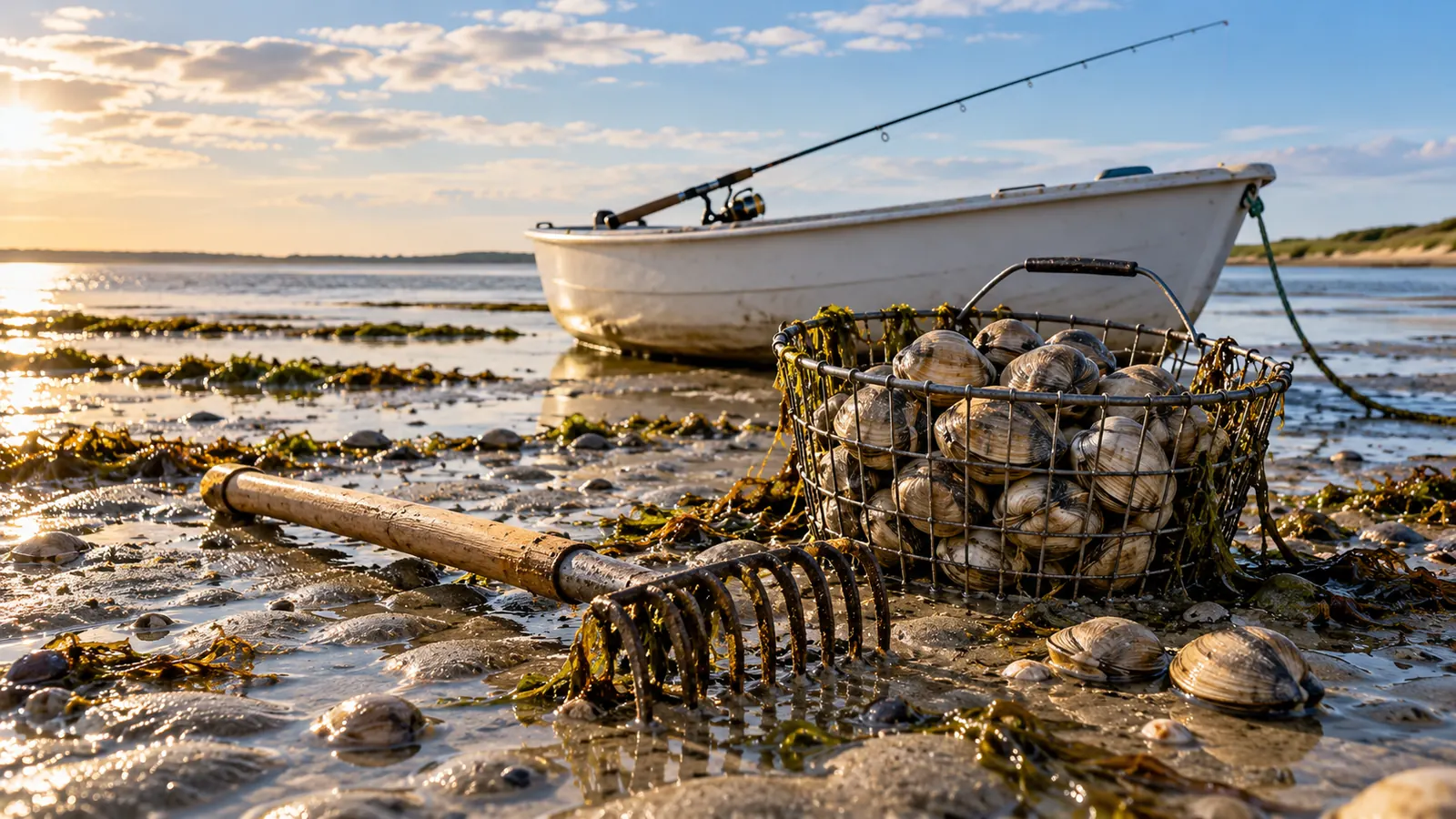
Cape Cod gives you three very different kinds of fishing within a few miles: surf casting on the ocean beaches, trout in clear kettle ponds and digging for clams on the tidal flats. Massachusetts treats them as three separate activities, regulated by three different authorities. Getting the right permit is easy once you know which one applies.
At a glance
| Activity | What you need | Issued by | 2026 cost |
|---|---|---|---|
| Fishing in salt water, from shore or a private boat | Recreational saltwater fishing permit | Division of Marine Fisheries | $10 (ages 16 to 59); free at 60+ |
| Fishing in freshwater ponds | Freshwater fishing license | MassWildlife | $40 resident, $50 non-resident, or 3-day $20 / $30.50 |
| Digging clams, quahogs or other shellfish | Town shellfish permit | The town where you dig | Set by each town |
| Recreational lobstering | Separate lobster permit | Through MassFishHunt | See state fee list |
The saltwater permit
Anyone 16 or older who fishes in Massachusetts salt water needs a recreational saltwater fishing permit. There is no boat permit, so every angler 16 and over on a private boat needs an individual one. Residents and non-residents pay the same: $10 for ages 16 to 59, and nothing at 60 or older, although seniors must still get the free permit.
You can buy it on the state’s MassFishHunt site and receive it the same day. Online purchase adds $3.38 to the $10 permit, made up of a $2.75 handling fee and a $0.63 convenience fee; a free permit costs $2.89 online. Approved vendors also sell it, and the Division of Marine Fisheries offices in Gloucester and New Bedford sell it by check or money order. Keep a printed or digital copy with you while fishing. Every permit expires on December 31.
Who does not need one
- Anglers under 16.
- Anglers on a permitted for-hire boat, such as a party boat or charter.
- Anglers who meet the definition of a disabled person in state law, Chapter 19C.
- Non-residents holding a valid Connecticut, New Hampshire or Rhode Island permit, under reciprocity rules that depend on where you live.
The permit covers Massachusetts marine waters out to 3 nautical miles and federal waters from 3 to 200 nautical miles. If you plan to fish for tuna, billfish, swordfish or sharks, you also need a federal Highly Migratory Species permit from NOAA Fisheries.
Freshwater ponds
The Cape’s ponds are freshwater, and they need a different license from MassWildlife. Nickerson State Park in Brewster, for example, has eight ponds, four of them stocked with trout year-round. For 2026, a resident license is $40 and a non-resident license $50, with 3-day licenses at $20 and $30.50. A $5 Wildlands Conservation Stamp is added to all non-resident licenses and to the first resident license bought each year. Residents aged 15 to 17 fish free, and the National Seashore notes children under 15 do not need a freshwater license. Online purchases carry a $2.75 administrative fee plus a 4.95 percent convenience fee.
Tip: There is no combined saltwater and freshwater license. If you plan to do both, buy both on MassFishHunt in one session.
Shellfish: a town matter
The state saltwater permit does not cover shellfishing. The Division of Marine Fisheries says recreational shellfishing is allowed in designated areas with a permit from the town, and it directs visitors to the town’s natural resources department for the permit and local rules. The National Seashore says the same within the park: shellfishing is permitted with a permit from the appropriate town.
That means fees, seasons, open days, daily limits and minimum sizes vary from town to town. The only reliable source is the town that issues the permit, so check its rules before you buy. Ask when you buy which flats are open to recreational diggers and on which days.
Check closures before every dig
Even an open flat can close overnight. The Division of Marine Fisheries posts emergency closure and reopening notices on Mass.gov, and recent Cape entries show the main causes:
- Rain. Heavy rain closes areas that reopen after testing, such as the October 2026 partial reopenings in Falmouth, Mashpee and Barnstable and in Bourne and Sandwich.
- Sewage. A sewage spill closed area SC28.8 in South Yarmouth and Hyannis on February 2, 2026; it reopened on February 20.
- Red tide. Paralytic shellfish poisoning closed part of Orleans on March 11, 2026, and Salt Pond in Eastham reopened after a PSP closure on July 10, 2026.
- Vibrio. In August 2025 oysters were closed in Orleans, Chatham and Harwich for Vibrio parahaemolyticus, reopening in early September.
Closures are listed by growing-area code, such as SC63 or OC6, so ask the town which code covers the flat you plan to dig, then check the list on the day you go.
Where you can fish
On National Seashore beaches, fishing from designated swimming beaches is allowed except from 8 a.m. to 6 p.m. between June 15 and Labor Day. Lots close at midnight, and night anglers can apply for a parking permit at a visitor center. Disposing of fish remains on park beaches is prohibited. See Cape Cod National Seashore Beaches: The Six Lifeguarded Beaches, Fees, Passes and Pet Rules.
Along the Cape Cod Canal, the Army Corps of Engineers allows bank fishing on federal property, with exceptions for its field office compound, boats, bridge piers and the railroad bridge approach spans. It warns that the rocky riprap slopes can be slippery and offers accessible fishing at the Sandwich bulkhead and the Scusset Beach fishing pier; more in Crossing the Cape Cod Canal: The Sagamore and Bourne Bridges and the Replacement Plan.
Sharks and seals share the surf with anglers on the Outer Cape. If you wade out to cast, read Sharks and Rip Currents on Cape Cod: What the Research Shows and How to Swim Smart first.